Custom CRM development for complex processes
Build a custom CRM that reflects how your teams sell, manage data, and interact with clients.
Discuss your CRM project
A CRM is customer relationship management software: a management system for customer data, sales activities, service requests, and related workflows. A CRM system becomes useful when people trust the information and can act upon it without exporting data between various tools.
CRM development services
Nomium offers custom CRM development for businesses seeking a reliable CRM rather than yet another layer of spreadsheets and manual work.
Process discovery and CRM strategy definition
Prior to a CRM development project, we conduct research and map the process, participants, data sources, and business needs. This allows us to separate the requirements that should go to the CRM from process improvements and integration with existing tools.
Architecture and product design
Here we define the CRM platform architecture, data model, permissions, integrations, and interfaces. The goal is to create a system that covers today’s process while being flexible in the future.

CRM application development
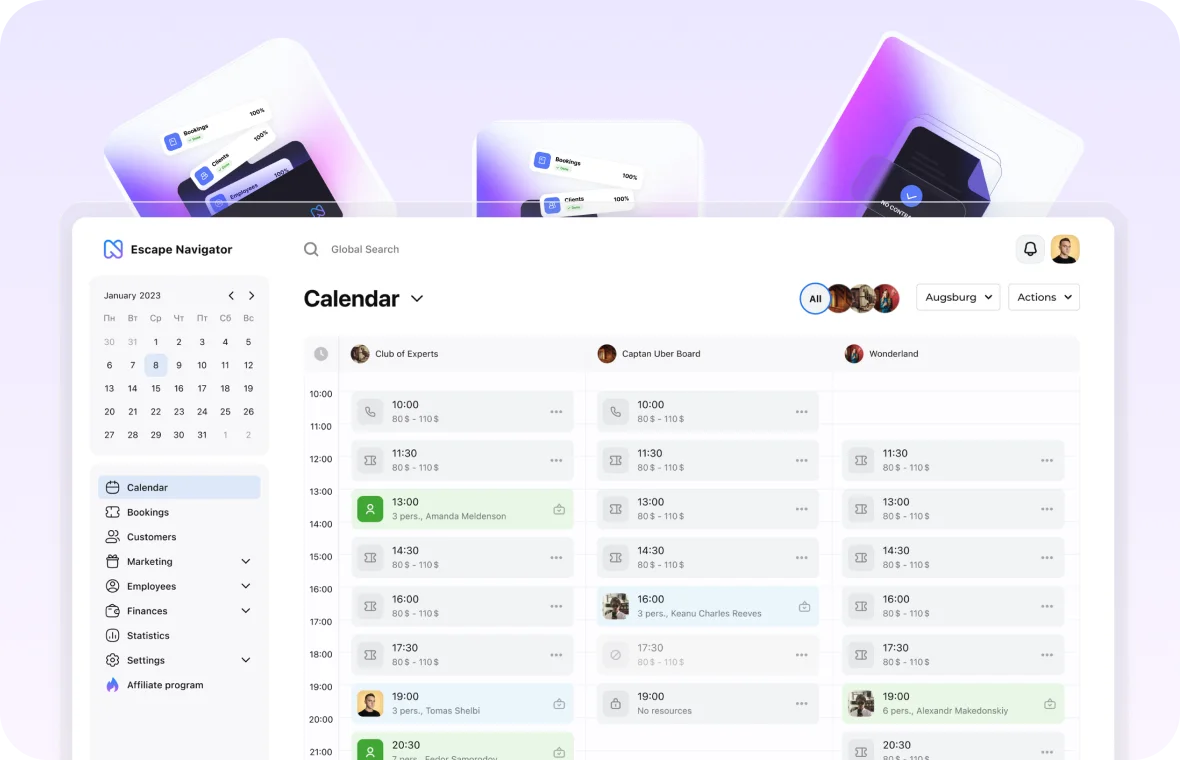
CRM development services cover web interfaces, backend development, APIs, dashboards, and custom reports. A CRM application may be used by sales, customer service, marketing automation, or other teams whose functions share the same customer record.

Integrations and data flow
A CRM usually is not an island. We connect it with ERP, billing, email, support, and other business software systems via APIs and data flows.
Features that a custom CRM might include
The feature set depends on the process the CRM is going to serve. A custom CRM app should begin with the smallest useful scope. Developing all possible screens at once is likely to make the new CRM hard to adopt and support.

Custom CRM software or an off-the-shelf CRM?
Off-the-shelf CRM
An off-the-shelf CRM might be useful for a common sales process when a company is ready to accept the limitations of the product's data model and configuration. Salesforce CRM, Zoho CRM, and other CRM providers offer wide ecosystems.
Custom CRM software
Custom CRM software represents a completely different direction. It gives a company full control over the data model, behavior, user experience, and integration boundary.
When to consider a custom CRM
In other cases – when the process itself is valuable, the data should be moved between multiple systems, or the teams require certain roles, custom fields, and approvals that cannot be easily represented with a standard CRM – you might want to consider a custom CRM solution.
Tech stack
The technology stack depends on the CRM system, integrations, security needs, expected load, and a client’s existing environment.




How we build custom CRM software
01
02
03
04
Why work with Nomium
-
Business and engineering approach
Nomium approaches bespoke CRM development as a business and engineering problem. Before implementing a CRM, we address scope, architecture, risks, and budget assumptions of the CRM project.
-
Custom, standard, or both
This gives stakeholders a clearer foundation for choosing whether to develop a custom CRM, configure a standard CRM, or use both approaches.
-
One team for the whole product
Our software development team works in backend, frontend, database, integrations, and DevOps domains. This allows us to discuss the CRM as a whole product, including data security, usability, scalability, and related systems.
Our work
Different goals. Different solutions. Here are a few examples.