Technical Due Diligence and Code Review Services
Independent technical due diligence for investors, acquirers, boards and founding teams.
We evaluate the codebase, software architecture, delivery process and scalability of a product, then report what is actually there and what it will cost to fix.
What technical due diligence is
Technical due diligence is an independent review of a company’s technology carried out before money or responsibility changes hands. It answers three questions: what has actually been built, what it costs to keep running, and what breaks when the product grows.
A technical due diligence assessment is not an opinion about coding style. It connects engineering facts to valuation, budget and business strategy, so the result can be used in a negotiation or in a planning cycle. Investors and acquirers use it to assess risk before a deal. Founders and CTOs use it to understand why software development has slowed down.
Five areas a tech due diligence has to cover
A technical diligence assessment is only useful when it follows the full delivery chain, not the source code alone. Our technical due diligence checklist covers five areas, and each one is capable of stopping growth on its own.
Product
Where the product earns, which KPIs are tracked, and the gap between the product roadmap and what is running in production.
Software architecture
A map of the system, its integrations and data flows, and the bottleneck that appears first when load increases.
Codebase
Code quality, maintainability, test coverage, technical debt and how quickly the code repositories absorb change.
Delivery
The CI/CD pipeline, release process, QA practice, incident handling and the real state of the backlog.
DevOps and infrastructure
Monitoring, logging, disaster recovery, data protection and the cost of running the environment at current and planned volume.
Our technical due diligence services
Nomium provides technical due diligence services on a scope agreed before the work starts. You pay for depth in the areas that carry risk in your case, not for a fixed template applied to every target company.
Software architecture assessment
We evaluate system design, modularity and integration points, and whether the architecture supports the growth described in the business plan.
Code review and code quality analysis
Manual review of the source code combined with automated code analysis: complexity, duplication, maintainability and coding practices across the codebases.
Scalability and performance review
We model traffic two, five and ten times higher than today and identify the scalability constraints that would surface first.
Cybersecurity and compliance review
Authentication, authorization, encryption, secrets handling and security protocols, plus the exposure that could turn into a breach or a failed compliance check.
Third-party and open-source dependency audit
Dependency versions, known vulnerability exposure, licence obligations and the risk each third-party component adds to the product.
DevOps and infrastructure review
Environments, deployment pipeline, observability, backup and disaster recovery, plus infrastructure cost per unit of usage.
AI and data readiness
Data quality and ownership, and whether AI features in the product are production systems or demonstrations built for a pitch.
Development team and process review
Team structure, ownership of critical knowledge, onboarding time, estimation accuracy and the product development workflow.
Code and infrastructure ownership check
Who owns the repositories, accounts and infrastructure, and what happens to the product if the current development team leaves.
Code review services
Code review services can be ordered separately from a full software due diligence when the question is limited to the state of the code. The same reviewers do the work, with a narrower scope.
Comprehensive code review
Structure, layering, error handling, naming and consistency across repositories and services.
Automated code analysis
Static analysis, linters and metrics: cyclomatic complexity, coupling, duplication and code churn.
Security-focused source code review
Input validation, access control, data security and handling of secrets and personal data.
Test coverage and QA review
What the test suite covers, what it does not, and whether it actually protects a release.
Technical debt review
Where the debt sits, what it costs the team per sprint, and which part is worth paying down before scaling.
Architecture review
Whether the current design carries the next stage of the product or needs remediation first.
When you need a technical due diligence
Technical due diligence pays for itself before a decision becomes expensive to reverse.
Buy-side technical due diligence in M&A
You are acquiring a target company and need an independent view of the technology behind the valuation, the integration effort and a realistic post-acquisition plan.

Sell-side technical due diligence
You are preparing for a sale or a funding round. Finding and remediating hidden risks yourself is cheaper than having an acquirer find them and reprice the deal.

Before an investment round
Investors ask whether the technology can carry the plan. A tech due diligence report answers that with evidence rather than with a deck.

Before scaling
Development slows down, releases become unstable and technical debt grows faster than functionality. A diligence assessment shows what has to be fixed before the product carries more load.

When the development team changes
The product has to be handed over, and someone independent has to confirm it can be maintained without the people who built it.

Our technical due diligence process
The technical due diligence process keeps the same structure on every project. The depth of each stage follows the scope agreed with you.
1
2
3
4
5
6
Hidden risks a technology due diligence uncovers
Most findings are not exotic. They are ordinary problems that stay invisible until the product is under pressure.
-
Technology that cannot scale
The architecture holds at current volume and stops holding at the volume written into the plan.
-
Concentrated knowledge
One engineer holds the critical parts of the system and nothing is documented, so onboarding a replacement takes months.
-
Security and compliance gaps
Weak security protocols, unmanaged secrets, no data protection process and no answer to an audit request.
-
Dependency and licence exposure
Outdated or unmaintained third-party libraries, unpatched vulnerability reports and open-source licences that conflict with commercial use.
-
Process inefficiency
Long release cycles, manual steps that should be automation, and a backlog that no longer reflects the product roadmap.
-
Demo-grade functionality
Features that exist in a presentation but not in production, which is a common reason a valuation and a codebase disagree.
What you receive after the diligence assessment
The output is written to be used, not filed. Each part answers a different question for a different reader.
Executive summary
The state of the technology, the main risks and what they mean for the deal or the plan, written for a non-technical reader.
Findings matrix
Every finding mapped as problem, impact, effort and priority.
Remediation roadmap for 30, 60 and 90 days
Quick wins first, then stabilization, then architectural improvements.
Pre-scaling fix list
What has to be corrected before the product takes more users, more data or more transactions.
Two review sessions
Technical detail with the engineering team, business context and actionable recommendations with you.
We review the tech stack a team actually runs in production: SaaS platforms, marketplaces, fintech and enterprise systems. If your framework sits outside our practice, we say so before the engagement starts rather than during it.






Why choose Nomium for software due diligence
A report is only as good as the people who wrote it and the decisions it lets you make.
Reviewers who build production systems
Our team has production experience with high-load infrastructure, so findings come from engineers who have shipped comparable software.
Business context first
Every technical finding is connected to cost, risk and business goals, which is what makes a report usable in a negotiation.
Independent opinion
We are not selling you a rebuild. If the technology is sound, the report says so, and we say which best practices are already in place.
Prioritized output
You receive a remediation plan a team can start on, not a list of observations.
Confidentiality
We work under NDA, with access limited to what the agreed scope requires.
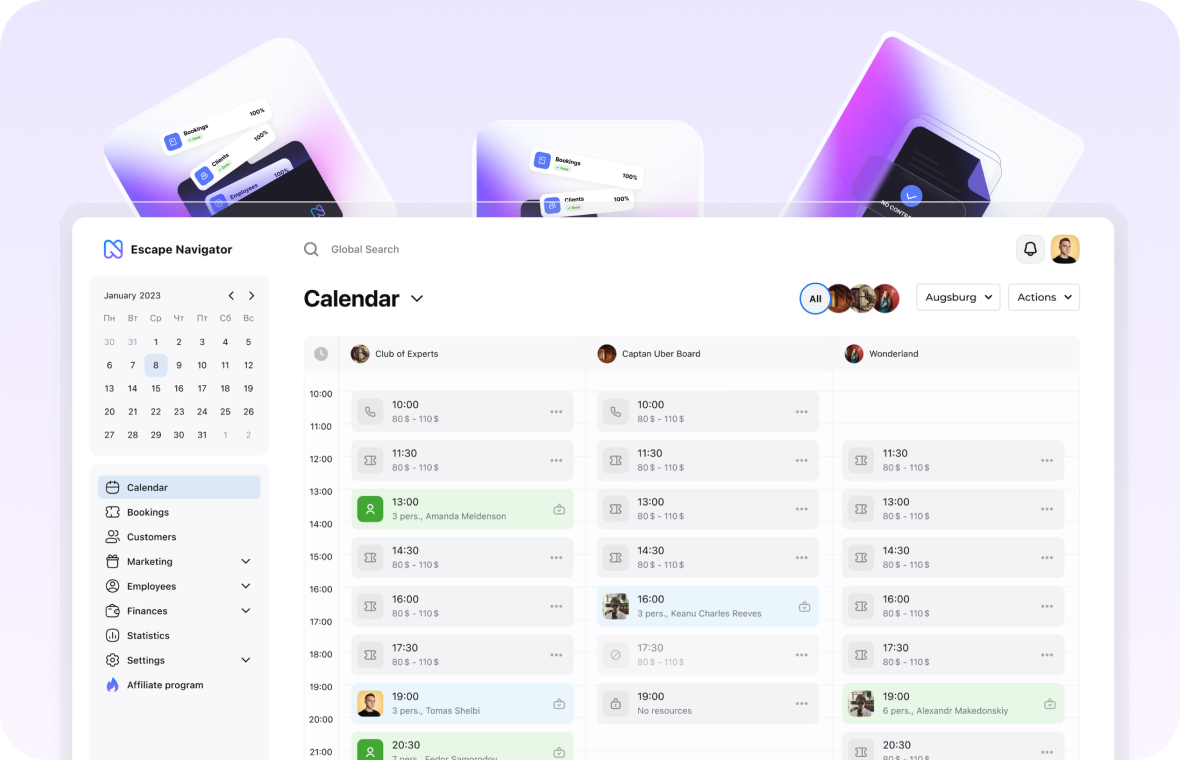
Different goals, different systems. A few examples of the products behind our review practice.