

What Is Gamification in Marketing? A Guide to Gamification Marketing
Gamification in marketing means using points, badges, and other game elements in the customer experience in order to motivate interactions with a brand. Put simply, gamification makes ordinary experiences a little more like a game, so customers feel motivated to engage and perform a desired action.
Such thinking lies behind nearly all gamification marketing campaigns – from a spin-to-win wheel to a loyalty program based on daily streaks. The sections below provide details about the concept of gamification marketing, its power to change behaviors, and its potential risks for marketers who fail to apply it thoughtfully.
What Gamification Marketing Means
Fundamentally, gamification marketing borrows game mechanics and applies them in a non-gaming situation. One popular definition, credited to researchers Sebastian Deterding et al., defines it as the application of game design elements in non-game contexts.
It’s important to distinguish between two ideas. While a full-fledged game is designed to entertain in itself, gamification adds an entertaining layer to an action a person was already performing. So, instead of playing a video game, a consumer plays with a progress bar, a leaderboard, or a ranking system, and the brand does not lose its seriousness.
The term is relatively new. It was introduced by British programmer Nick Pelling back in the early 2000s, but became popular in digital marketing due to the rise of smartphones and apps. Gamification has been influential in marketing since then, and today it appears everywhere from a website to an email message or a social post.
Why a Modern Marketing Strategy Needs Gamification
Gamification works best when applied in tandem with the overall marketing strategy. Nearly all gamified marketing campaigns are just elements of larger marketing strategies, aimed at objectives such as sign-ups, better retention, or stronger relationships with customers.
In comparison with traditional marketing, which addresses its audience directly, gamification asks something from the audience instead. This subtle shift from broadcasting to inviting participation increases memorability, as people always remember what they do better than what they watch. A gamified poll can become part of an email flow, a progress bar can assist onboarding, points can become a part of a loyalty program – a game layer just enhances the marketing efforts a brand already conducts.
Game Elements in Marketing Campaigns
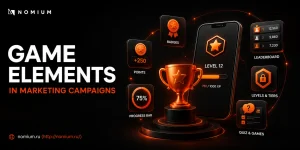
Gamification marketing is based on a combination of game elements, which are selected depending on marketing objectives. There are several game elements in particular that work perfectly for marketing purposes as they are very close to people’s needs and motives.
The most popular game elements are:
- Points earned while shopping, reading, or sharing, providing progress feedback;
- Badges awarded when the customer reaches some milestone, creating a kind of trophy for customers to show to others;
- Leaderboard that ranks people and inspires them with the idea of competition;
- Progress bar showing the distance to a reward;
- Levels or tiers that unlock exclusive offers;
- Quiz or any game that engages the customer and collects useful information simultaneously.
Each of these game mechanics performs one function: it provides feedback. And the feedback in a gamified experience is essential: people get satisfied with the movement of the bar and the appearance of badges, and that makes gamification different from a simple form or banner. The gamified experience usually contains several game mechanics because some people enjoy competing and others enjoy reaching goals.
The elements mentioned above do not need to be digital: a stamp card in a coffee shop is a progress tracker, and a scratch card is a game of chance, and in both cases the psychology behind gamification is the same regardless of the format being paper or digital.
Why Gamification in Marketing Works: Customers’ Motivation
The power of games consists in the ability to appeal to basic human drives, and gamification marketing appeals to the same motivational triggers. Some basic human drives are the following:
- Achievement. Completing a task and receiving a reward brings a sense of achievement that encourages repeating the behavior.
- Status. Leaderboards and visible badges help customers show their success to others and satisfy the desire for a sense of community.
- Curiosity. A chance to win something or find some hidden reward increases interest in an activity.
- Autonomy. The possibility to choose a path makes participation voluntary.
It’s obvious that gamification is not just rewarding someone with prizes. Such an extrinsic motivator can kick off a certain behavior, but the intrinsic motivator is much deeper and motivates people to come back to the activity again and again because they like it. Gamification marketing creates trust, as customers appreciate receiving meaningful rewards for real effort, and that turns a single experience into a habit.
Gamification and Customer Experience
Gamification is actually a way of influencing customer experience. Instead of asking someone to complete a boring step, gamification reframes this step into an interesting event that influences people’s perception of the brand.
Enhancing customer experience by making it more playful also improves customer engagement and user engagement, as people are willing to stay with the brand longer because it responds to their actions. The goal is to create a gamified experience that helps customers achieve a real goal faster and improves the overall user experience.
That’s also why it’s important that the reward corresponds to a real action. When customers receive something valuable in exchange for something real, the experience is considered fair. And only a fair experience can create long-term trust in a brand. Any game layer that gives meaningless points fails eventually.
Benefits of Gamification in Marketing
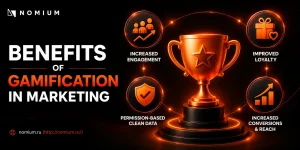
The value of gamification in marketing is obvious: it delivers measurable results. With a proper approach, it helps to boost customer engagement, improve loyalty, and collect valuable data.
Increased engagement
The main benefit is increased engagement. Interactive marketing content asks people to do something, and a well-designed interactive game keeps people longer than a static ad, increasing both audience and customer engagement.
Improved loyalty
With the help of a gamified loyalty program, customers will be rewarded for repeated interactions and develop the habit of coming back. So, the rewards program turns into a source of loyalty over time.
Permission-based clean data
Interactive content like a quiz or a poll asks people to share something. As customers opt in to receive a reward, a brand can collect valuable data without intruding.
Increased conversions and reach
Interactive experiences can increase conversion rates as they direct people towards a certain action. For instance, a spin-to-win offer can increase conversions during the checkout process, while the results can be posted on social media and increase the reach of a brand almost for free. The interactive experience also attracts website visitors who don’t respond to standard marketing offers, helping to increase customer acquisition and brand awareness.
Want to turn game mechanics into real business results?
At Nomium, we develop a variety of gamification services — ranging from blockchain-powered reward and loyalty programs to interactive applications that transform game mechanics into actual outcomes. From a short-term project to a long-term campaign, our team will help you design and develop it.
How to Gamify Your Marketing Strategy
There is no need for a big budget to start. What really counts is the right combination of mechanics to reinforce your marketing and business goals, and not novelty for its own sake.
Start from the objective, not the game
First of all, define your objective. Whether it’s more sign-ups, higher retention, or better data, the choice affects the design of the gamified experience, and having a certain objective helps to understand the results better.
Match the mechanics to your audience
The audience’s preferences affect the choice of a gamified experience. A younger audience is used to online games and will prefer a fast and competitive experience, while a professional audience will be more satisfied with a progress bar leading to a useful result.
Keep it simple and rewarding
Complexity kills the motivation, and a combination of one action, a visible reward, and instant feedback wins over a complicated experience every time. Participants should know exactly what their goals are.
Blend gamification across channels
Gamified content works on a website, email, and in-app. You can use a quiz on a landing page, or reward points in a newsletter, and consistency of your gamified experiences will attract customers everywhere they see your brand.
Use gamification to promote products and services
A gamified campaign can help to promote new products or services. A memory game or a personality test will allow you to show some features of your product or service, encouraging customers to try it.
Measure and improve
Monitor the number of participants, the completion rate, the conversion that follows, and the frequency of returns. Interactive campaigns generate plenty of data, and you can use it to understand customer motivations and improve your gamification experience.
If the brand is interested in new business models, then a gamification experience based on blockchain technologies will be a good choice. Tokenized points and digital collectibles allow customers to own the rewards they earn in a gamified experience, and this increases loyalty over the long term. To get started with gamification based on blockchain technology, you can use the services of a blockchain development agency like Nomium.
Examples of Successful Gamification Marketing
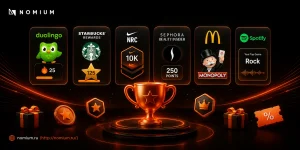
The examples below prove that successful gamification marketing involves a reward for real participation in an activity.
- Duolingo turns language learning into a daily routine with the help of streaks and points.
- Starbucks Rewards allows its customers to collect stars and advance to a higher tier with every purchase, bringing them one step closer to a free gift.
- Nike Run Club rewards runners with badges and personal achievements and builds a community around them.
- Sephora uses its Beauty Insider program that includes points, tiers, and special offers to reward the most loyal clients.
- McDonald’s Monopoly makes the routine purchase even more appealing with a chance to win, a long-running gamified marketing campaign.
- Spotify Wrapped helps its customers to see their music preferences during the year in the form of a visual report and share it.
All of these campaigns have one thing in common: each of them rewards a real behavior the brand wants its customers to have. That’s why gamification does not look strange in them, and customers accept it naturally.
The same principle can be observed even in smaller campaigns for online stores. A progress bar unlocking free shipping or a pop-up offering a discount in exchange for a subscription makes the customer complete the next step without feeling pressure. It explains the popularity of gamification in ecommerce.
Common Mistakes to Avoid in Gamification Marketing
There are mistakes marketers usually make when gamifying a campaign. It helps to know what pitfalls to avoid before starting the gamification campaign.
- Rewarding the wrong action. Customers will start manipulating the points if it’s easy.
- Overcomplicating the rules. It’s better not to make a complicated structure if there is no need for it, as it decreases the participation rate.
- Ignoring the principle of fairness. A ranking board which favors only some customers discourages others.
- Considering it a one-time solution. A single contest produces a spike of activity, but not a regular pattern. Sustainable results come from a long-lasting gamification strategy.
The solution is quite simple – to connect the mechanics to a real value for customers, as when a reward is real and the efforts are reasonable, gamification will help a brand instead of distracting from it.
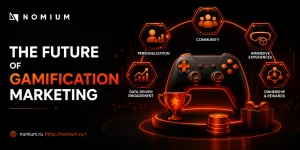
The Future of Gamification Marketing
Gamification is developing constantly, as brands learn what works in gamification. Now, personalization is one of the main trends in this field: brands use customer behavior data to adjust rewards to each customer and make the experience more relevant.
Immersive and community-based gamification experiences are also gaining popularity. For instance, augmented reality allows turning store visits and social posts into games, while user-generated content campaigns encourage people to participate actively. Another trend is ownership: blockchain-based rewards and tokenized loyalty points enable customers to own something they earn in the gamified experience, and it strengthens the bond with the brand.
With these developments, gamification will become part of a sustainable relationship between the brand and customers rather than a one-off promotion. For marketers, gamification will transform from a trend into a discipline.
Frequently Asked Questions
What is the definition of gamification?
Gamification means the application of game mechanics, such as points, badges, and leaderboards, in non-game situations. When it is used in marketing, gamification means applying the elements of games in the customer experience in order to motivate people.
Why is gamification marketing effective?
It is based on basic human motives, such as progress, achievement, or recognition. When an interactive experience offers a reward and feedback, people become more willing to participate in it, return, and remember a brand.
What are the game elements in gamification?
The main game elements used in gamification marketing are points, badges, a ranking system, tiers or levels, and a progress bar, often combined with an interactive game or quiz.
How does gamification influence customer loyalty?
A gamified loyalty program rewards customers with points, streaks, or offers, encouraging them to come back. Over time, customers become more loyal to the brand.
How can businesses use gamification in marketing?
First, a business needs to define an objective, choose a simple mechanic that fits its target audience, and add it to the channels it already uses: a website, email, or an app. After that, it needs to monitor and adjust the gamification mechanics to the objective.
How does gamification allow gathering useful data?
Interactive quizzes and polls let brands gather customer information in exchange for a reward. As customers participate voluntarily, brands gather real data without using any third-party personal data.
What is the danger in a gamified campaign?
Problems can occur if the brand rewards customers for a wrong action, makes the rules too complicated, or tries to conduct a one-off contest. The solution is to make the experience simple, fair, and related to real value for customers.
What is ecommerce gamification?
Ecommerce gamification is gamification of online shopping with such game elements as spin-to-win discounts, a progress bar towards free shipping, and reward points at checkout.
Rate this article!








Leave your comment