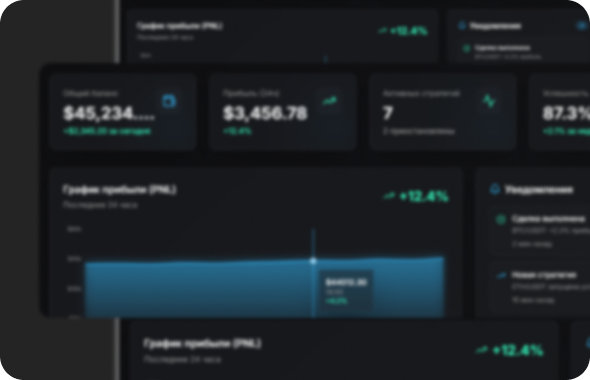
Crypto mining monitoring: miner control system
A platform for miner monitoring, hashrate control, and remote ASIC management. Scales from a single farm to tens of thousands of machines. We build turnkey solutions or deploy the ready-made Nomium Monitoring system — on your infrastructure, hardware, and business processes.
Discuss your task
Nomium develops monitoring and fleet management systems. We design and build systems from scratch, adapted to your infrastructure, ASIC models, and business processes.
Miner Monitoring System Features
All the tools you need to monitor and manage your equipment — in one place.
Real-Time Telemetry
Hashrate, temperature, power consumption, and uptime for each device are updated automatically. The site map shows physical location: site, container, rack, slot. Color indicators immediately highlight problems — the operator sees a fault without searching through lists.
Remote Miner Control
Change operating mode, reboot, switch pool — for one device or thousands at once. Each command is considered complete only after actual confirmation from the device. You can see which devices executed the command and which did not.

Scheduled Operating Modes
Weekly templates and events: set the time for a mode change — and the system executes it automatically, without operator involvement. One schedule applies to hundreds of devices simultaneously. Conflict warnings are displayed in advance.

Notifications and Event Logs
Every event has a priority level — from informational to critical. Notifications are delivered to the right channel: email, SMS, or push. All events are tracked — whether the message was delivered and read or not. Each device has its own event log.
Equipment Repair and Service
Full ticket lifecycle — from start to finish: status, site, model, serial number, service center, warranty, and more. Every action is recorded in the history. Quick filters let you find any ticket in seconds.
Firmware Updates
Firmware compatibility with the device model is verified before updating. Fleet-wide updates are optimized into a single action. An update is considered complete only after the device reboots and reconnects under the new firmware version.
Roles and Permissions System
All equipment is managed exclusively through the monitoring service, with every user action verified. Direct ASIC access for staff is blocked. The flexible permissions system enforces strict access controls based on site, user role, and operation type.
What changes when you use mining monitoring?
| Without a monitoring system | Mining monitoring with Nomium |
|---|---|
| Status, commands, and faults are scattered across different places | Unified information loop: status, commands, and events in one place |
| Manual data collection and coordination between tools | Central management with no manual coordination required |
| Root cause analysis takes several hours | Root cause identified in under a minute |
| Mass operations are hard to track by outcome | Mass operations with real execution and outcome tracking |
| Repairs without a unified history or ticket statuses | Repair tickets, statuses, and action history for every faulty device |
| Fleet growth increases the risk of losing control | Scaling up does not affect infrastructure control |
| Staff have direct access to ASIC miners | All actions go through the monitoring service with confirmation and a roles system |
Who are miner monitoring systems for?
Our solutions are suitable for any scale and format of mining equipment operation:
If you manage mining infrastructure and spend time on manual checks, tool coordination, or tracking down downtime causes — we know how to solve that.
-
Mining farms and data centers with fleets from 50 to 100,000+ devices
-
Hosting providers and mining hotels managing client equipment
-
Owners of large ASIC miner fleets who need full control
-
Companies actively expanding their infrastructure and in need of process automation
-
Management companies that prioritize security and are ready to eliminate direct staff access to equipment
We use proven technologies to build mining monitoring systems for production environments:




Mining Monitoring System Development Stages
From requirements analysis to testing and launch.
01
02
03
04
05
06
Why Clients Choose Nomium
for Monitoring System Development
-
A Ready-Made Solution at the Core
Our ready-made solution lets you build a mining fleet monitoring system on a proven architecture, with known solution boundaries and predictable timelines — no building from scratch, only adaptation to your requirements.
-
Expert Knowledge of Mining Infrastructure
We know the specifics of ASIC protocols and how miners such as Antminer, Whatsminer, and others work. We understand every aspect of mining hotel and hosting operations. This knowledge greatly simplifies development and minimizes design risk.
-
Scalability Without Losing Control
The monitoring system is designed for fleets of several hundred thousand devices. Adding new sites and devices requires no architectural changes — the system is designed for this from the start.
-
Transparent Development
You receive all source code, documentation, and a full understanding of how the system works. You are vendor-independent — free to develop the product further on your own or with another team.
-
One Team for the Full Project Cycle
You get a single team that handles every project stage — from architecture through launch and ongoing support.
Different goals. Different solutions. Here are a few examples.