

An interactive game for the aviation museum
“House of Aviators”
Web development
2020 January – April



How the idea came about
Today it is hard for museums to hold visitors’ attention, especially that of the younger generation. Static exhibits and labels belong to the last century.
We received a request from an aviation museum: create something that would be interesting to children and teenagers, while preserving the educational essence of the exhibition.
Our proposal — an interactive game built into the museum exposition.
Project goals

Increase
engagement
Give every visitor the chance to “fly” a virtual plane, completing missions either alone or together with friends.
Ensure
easy access
Launch the game without installation or registration, so that starting takes just a few seconds.
Link the game
to the exhibits
Combine the game’s storyline with real exhibits, preserving the museum’s core educational goal.
Collect
and analyze data
Track the number of players, time spent in the game, and how successfully missions are completed.
Concept and mechanics
To keep every session interesting and unpredictable,
bots appear and get in the way of completing the mission.
The storyline is based on historical events: as they complete
missions, players uncover facts about the exhibits and can walk up
to them to learn more.
We proposed an aerial combat format: the player controls a plane on
a smartphone, dodges obstacles, destroys enemies, and collects bonuses
UX design
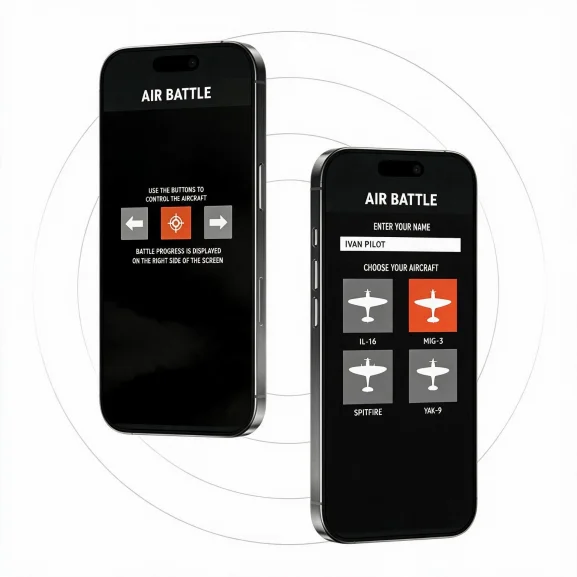
The game’s interface is done in a
retro-futuristic style: bright colors, smooth
animations and illustrations that recall
the golden age of aviation.
We paid attention to accessibility: large controls, explanatory hints, and adaptation to different screen sizes.
The controls are as simple as they get —
one finger is enough
to maneuver the plane.
How the work was organized


Results and impact

in the game by each user
participants per month
Increased interactivity
Visitors didn’t just look at the exhibits, they actively interacted with them through the game, discovering new knowledge about the history of aviation in Russia.

Positive feedback
Visitors noted that the game adds “liveliness” to the exhibition, and museum staff noted that the exposition has become appealing to schoolchildren and students.
Further development
Right now we are working on adding new missions, integrating an audio guide, and launching the game in other halls of the museum.

Conclusions
With a simple and accessible game, the “House of Aviators” museum managed
to draw visitors into the history of aviation and turn a walk through
the exposition into an interactive adventure.
The case shows how digital technologies and gamification help
cultural institutions stay relevant and appealing.
Other projects we have delivered
We transform ideas into successful solutions with proven expertise.