

Automatic payment
identification system
identification system
Crypto payment automation for an exchange service
facing rapid growth in turnover
and transaction volume.
while clients expected fast deposits
and instant withdrawals.
from receiving funds and identifying the client to analytics and
withdrawing funds, eliminating manual operations.
Problems
Identification difficulties
Clients paid from exchanges (Binance, Bybit) that use shared addresses. The administrator could see the payment but couldn't identify the sender.
Lack of scalability
Every new transaction required manual processing. The system couldn't keep up with the growing number of clients, which made scaling the business impossible.
Manual transaction processing
Operators manually reconciled transactions, clarified details with clients, and withdrew funds from each wallet separately. This led to errors and significant time costs.
Solution architecture:
a full automation cycle
a full automation cycle
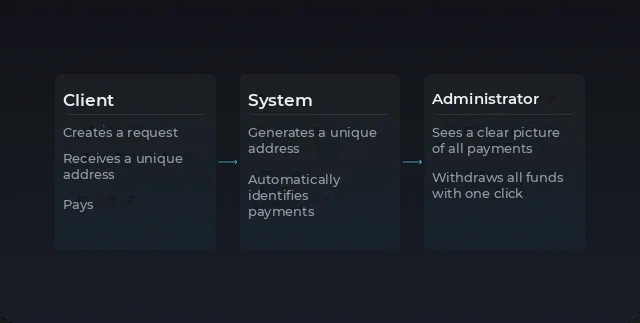
We designed a solution that fully controls
the movement of funds: from incoming payment to final withdrawal —
without operator involvement.
A unique payment address
for every client
smart-contract address, links it to a specific client
and transaction, and tracks incoming funds in real time.
As a result, every payment can be precisely linked to a client,
transfers from exchanges are no longer a problem, and manual reconciliation is no longer needed.
Centralized dashboard and analytics
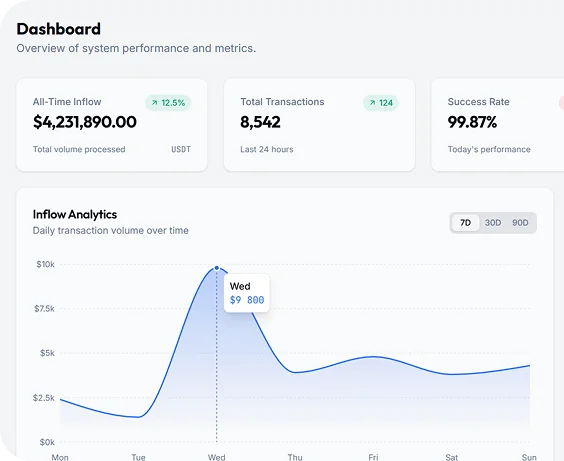
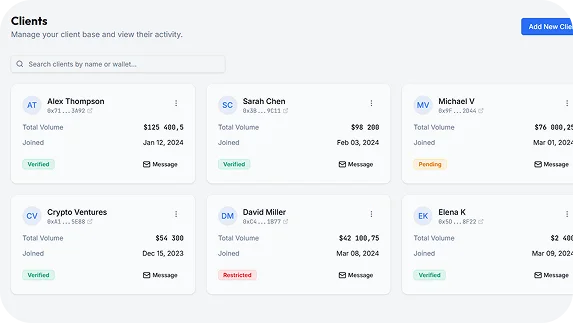
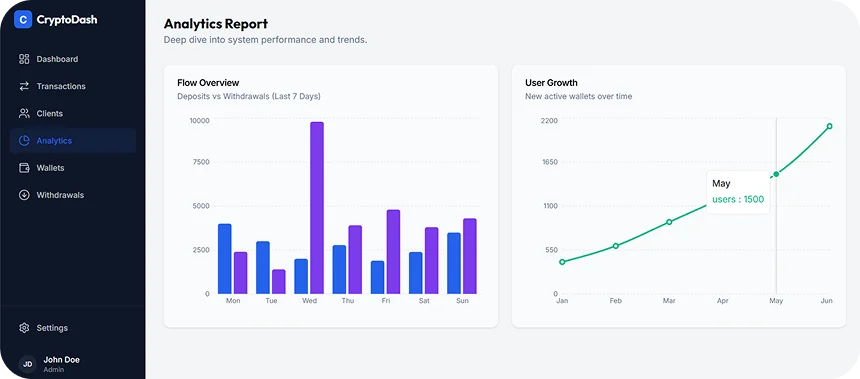
A single admin interface combines a dashboard with key metrics,
a transaction list,
client data, analytics, and wallet management.
All operation data is collected automatically and available in real time.
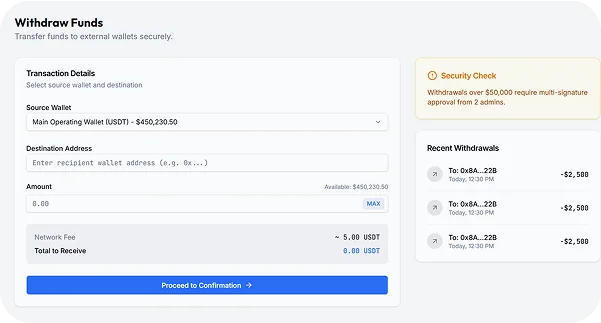
Unified fund withdrawal
Funds from all individual addresses:
– are automatically consolidated,
– are gathered into the company’s main wallet,
– are withdrawn through a single interface.
The administrator no longer works with dozens of wallets manually.
The withdrawal process takes minutes instead of hours.
Implementing the system allowed the client not only to solve the initial problems, but also to lay the foundation for future growth.
Impact and results after the system launch
Efficiency
Payment identification errors have been eliminated. Transaction processing time has dropped several times over thanks to the complete removal of manual operations.
Scalability
The system is ready for growth in clients and transactions without expanding the team or losing service quality. The architecture is designed for further development and the integration of new payment sources.
Economics
Operational processing costs have been reduced by approximately 70% thanks to automation and a reduced load on operators.