

Web3 Application Architecture: How the Backend, Frontend, and Integrations Work

Web3 Application Architecture: How the Backend, Frontend, and Integrations Work
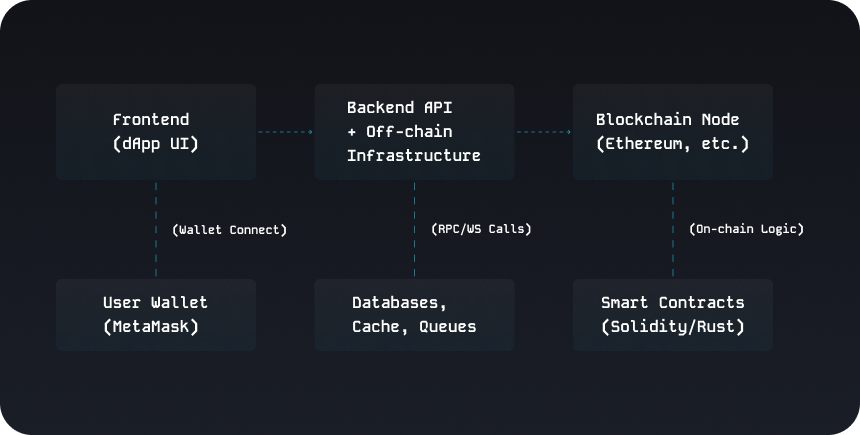
Building Web3 applications takes more than just smart contract expertise. Behind every successful dApp is a mature architecture where the blockchain is only one part of the system.

This article is designed to help technical leaders understand how to architect Web3 applications that can handle real-world load, scale reliably, and deliver a fast, intuitive, and secure user experience. We take a detailed look at which responsibilities belong on-chain and which are better handled off-chain.

What Is a Web3 Application from a Technical Perspective

From a technical perspective, a Web3 application (dApp) is distributed software where critical business logic and ownership data are executed and stored on a public blockchain (on-chain), while the interface, complex computations, data aggregation, and user session management remain in off-chain systems, either centralized or decentralized.

The main difference from a traditional web application lies not in the absence of a backend, but in a shift of state ownership. In the classic model, the server acts as the single source of truth for user balances and digital asset ownership. In Web3, this responsibility is transferred to smart contracts on the blockchain. The backend no longer serves as the primary data store and instead becomes a layer that validates blockchain data, synchronizes it, and prepares it for convenient use.

The following components typically remain centralized:

  • The user interface (frontend), hosted on a server or CDN
  • Server-side services for background processing, indexing, and advanced analytics
  • Databases used for caching, sessions, and non-critical data
  • Session-based authentication mechanisms (e.g. JWT), which complement but do not replace wallet-based transaction signing

As a result, the CTO’s task is not to remove servers, but to design a system where servers trust the blockchain as the source of truth, interact with it efficiently, and provide users with a fast interface for working with a distributed system that is inherently slower than traditional web infrastructure.

Core Architecture of a Web3 Application

The architecture of a typical dApp can be divided into three interconnected layers. Their interaction ensures the integrity of the application.

Frontend (dApp UI):
Most commonly built with React / Next.js or similar frameworks. Its primary role is to provide an interface for initiating actions that require interaction with smart contracts. The frontend itself does not have direct access to the blockchain; instead, it relies on a provider supplied by the user’s browser wallet (e.g., MetaMask) or services such as WalletConnect.

Smart contract layer:
This is the core of the application, deployed on the blockchain. Business logic is written in specialized languages (Solidity for EVM-based networks, Rust for Solana). Once deployed, the contract code and its state are immutable, which imposes strict requirements on code quality and security. Computation at this layer is expensive (gas fees), and throughput is inherently limited.

Backend and off-chain infrastructure:
Often underestimated, but critically important. This layer typically includes:

  • Backend API: Used for authorization, profile management, and handling data that does not need to be written on-chain.
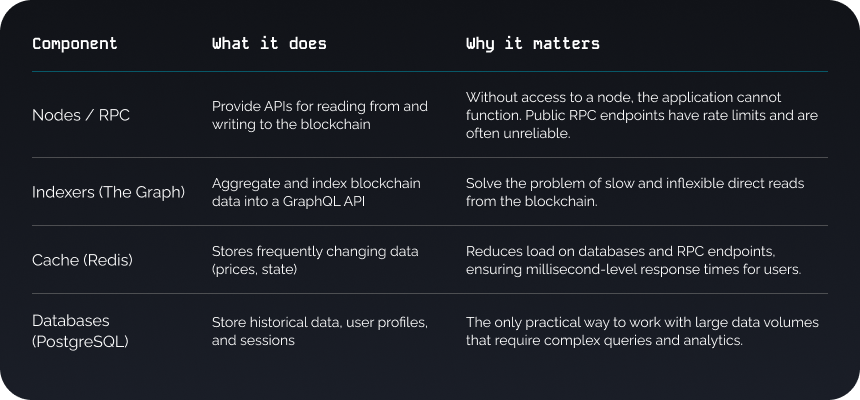
  • Nodes (RPC): Self-hosted or provided by third parties (e.g., Infura, Alchemy) to read blockchain state and submit transactions.
  • Databases (e.g., PostgreSQL): Used for caching on-chain data, aggregating analytics, and storing user sessions.
  • Cache (e.g., Redis): Enables fast access to frequently requested data, such as current prices or user state.
  • Message queues (e.g., RabbitMQ, Kafka): Support asynchronous processing of blockchain events, notifications, and compute-intensive tasks.

The connection between on-chain and off-chain components is established through smart contract event subscriptions. By monitoring these events, the backend keeps its database in sync with the blockchain state, enabling fast responses for the UI.
How the Frontend Interacts with the Blockchain

The frontend does not interact with the blockchain directly. Instead, it communicates through a provider injected into the browser by the user’s wallet (for example, window.ethereum). Wrapper libraries such as ethers.js or web3.jsstandardize and simplify this interaction.

A typical flow for an operation like minting an NFT looks as follows:

  1. Request:
    The user clicks the “Mint” button. The frontend uses ethers.js to construct a call to the smart contract function.

  2. Signing:
    The request is forwarded to the user’s wallet (e.g., MetaMask). The wallet displays the transaction details and gas fees. The user signs the transaction with their private key.
    Important: the application never has access to the private key.

  3. Submission:
    The signed transaction is sent to the network via a connected RPC node. The frontend receives the transaction hash (txHash).

  4. Waiting:
    The frontend enters a loading state and periodically queries the RPC node (for example, via eth_getTransactionReceipt) using the txHash to check whether the transaction has been included in a block.

  5. Confirmation:
    Once the transaction receipt is available, the frontend extracts the emitted events and updates the UI accordingly.

Common UX-breaking issues at this stage include missing loading indicators, unhandled wallet errors (such as user rejection), incorrect gas estimation, and ignoring the required number of block confirmations.

The Backend as a Critical Component of Web3 Applications

The claim that Web3 applications do not need a backend is a common misconception. A real-world dApp cannot function without a robust off-chain infrastructure that handles the following responsibilities:

  • Data validation: Before prompting a user to sign a transaction, the backend must validate it (for example, check sufficient balance and correct parameters) to prevent costly on-chain errors.
  • Event subscriptions and synchronization: The backend listens to smart contract events (typically via WebSocket subscriptions). When a new event is emitted (e.g., a Transfer), it updates the corresponding records in its database, keeping frontend state in sync.
  • Caching and aggregation: Computing a user’s historical portfolio or rendering a trading pair chart requires aggregating thousands of transactions. Doing this through direct RPC calls is prohibitively slow and expensive. The backend performs this work once and stores the results.
  • Transaction queues: To avoid nonce conflicts and manage transaction priority, transactions are often queued (for example, in Redis or RabbitMQ) and submitted sequentially.
  • Bot protection: Mechanisms such as rate limiting or CAPTCHA, which cannot be implemented on-chain, are entirely handled by the backend.

Example: why a fully on-chain application is not feasible

Consider an NFT marketplace. Search and filtering by collections, attributes, or prices require full-text search and complex queries. Implementing this inside a smart contract written in Solidity is technically impractical—and even if it were possible, the cost of a single query would be astronomical. The standard solution is an indexer (such as The Graph) or a custom backend that listens to mint and transfer events and stores metadata in a database optimized for search.

Infrastructure: Nodes, RPC, Indexing, and Caching

A stable and fault-tolerant infrastructure is the foundation of a reliable dApp.

Running your own nodes provides full control and independence, but it also comes with significant operational overhead. Node providers such as Infura and QuickNode offer managed, scalable infrastructure with load balancing and monitoring built in.

For production, a failover strategy is mandatory: if the primary RPC provider goes down, the application must automatically switch to a backup endpoint.

Security in Web3 Applications

Security in Web3 requires a holistic approach across all layers.

Frontend vulnerabilities:
The most common attack vector is phishing through frontend weaknesses. An attacker can exploit an XSS vulnerability to replace a contract address or alter transaction parameters in the UI, tricking the user into signing a malicious transaction. WalletConnect integrations require strict domain validation to prevent MITM attacks.

Public RPC risks:
Using shared public endpoints can lead to transaction censorship or interception. Access to your own node or a trusted provider should be protected with API keys and IP allowlists.

Smart contract security:
Primary risks include reentrancy attacks, integer overflows, flawed pricing logic, and delegated calls (delegatecall) to untrusted contracts. Multiple audit rounds and extensive testing on test networks are mandatory.

Common Mistakes in Web3 Application Development

Experience from failed projects reveals a set of recurring architectural mistakes:

  • Lack of a well-designed off-chain layer. Attempting to push all data and logic on-chain results in prohibitive user fees and makes even basic functionality impractical.
  • Placing critical business logic in the UI. For example, enforcing access conditions only on the frontend. An attacker can bypass the UI entirely and submit a transaction directly to the contract.
  • Incorrect event handling. Errors in processing blockchain events (for example, during chain reorganizations) lead to desynchronization between off-chain databases and the actual contract state.
  • Poor nonce management. Sending multiple transactions in parallel with incorrect nonce calculation causes transactions to get stuck in the mempool.
  • Missing data synchronization architecture. When every UI request triggers a direct RPC call, the application becomes unacceptably slow and quickly hits provider rate limits.

Use Cases: How Architecture Solves Real-World Problems

Case 1: High-Traffic DeFi Protocol

Problem: A sudden spike in users during periods of high market volatility. Direct RPC calls for balances and prices cannot keep up, causing the UI to lag.

Architectural solution: Introduction of a multi-layer caching strategy. Prices are updated via oracles and cached in Redis with a TTL of a few seconds. User balances are updated asynchronously by subscribing to transfer events and persisted in PostgreSQL. The frontend requests fast, aggregated data from the backend instead of querying the blockchain directly.

Result: A stable, responsive UI even under extreme load on the Ethereum network.

Case 2: NFT Marketplace

Problem: The need for fast search and filtering across thousands of NFTs based on metadata (attributes, rarity).

Architectural solution: Use of a decentralized indexer such as The Graph. NFT metadata (stored off-chain, for example in IPFS) is indexed via a subgraph. The frontend issues GraphQL queries to the deployed subgraph to instantly retrieve filtered results.

Result: A user experience comparable to Web2 marketplaces, while preserving the decentralized nature of the data.

Case 3: Web3 Trading Dashboard

Problem: A trader needs a real-time, consolidated view of assets across multiple networks and protocols.

Architectural solution: A backend aggregation service that periodically collects data for each wallet across multiple blockchains and smart contracts via multi-RPC, computes the total portfolio value, and stores snapshots in a database. The UI consumes data directly from this database.

Result: Instant loading of a complex, cross-chain portfolio instead of minutes of waiting.

Conclusion: How to Approach Web3 Application Architecture

Web3 application development is fundamentally about designing hybrid systems. The key takeaway is simple: the blockchain is not a replacement for a server, but a deterministic, trusted layer for critical logic and state. Everything else in the application should be built around it to deliver speed, scalability, and usability.

A successful architecture is based on a clear separation of responsibilities: what belongs on-chain and what should remain off-chain. Smart contracts are responsible for asset ownership and guaranteed rule execution. The backend and frontend are responsible for making those assets and rules accessible at human speed and with a usable interface. Invest in reliable RPC infrastructure, design proper indexing and caching strategies, and never neglect security at every level—from contracts to the UI.

A disciplined architectural approach turns Web3 from a technical challenge into a competitive advantage for your product.

Get an Architectural Consultation for Your Web3 Project

Get in touch if you’d like an architecture review, on-chain/off-chain interaction design, or an analysis of your current system.

Share

Copy link Link copied!

Rate this article!

Leave your comment

Submit By clicking the "Submit" button, you are giving your consent to the processing of personal data and agree to the confidentiality policy