

Where and How to Use Smart Contracts in Business: From Logistics to Finance
How many deals have fallen through because a partner forgot the terms or misunderstood the contract? Now imagine a contract that cannot physically be broken.
The secret? Smart contracts.
While some argue whether this is a revolution or a gimmick, other companies are making money from technology that works reliably and accurately. Let’s take a look at where smart contracts solve business problems and bring in real money.
What are smart contracts and how do they work?
Smart contracts are digital intermediaries that automatically execute the terms of agreements without the involvement of third parties. They work on an “if-then” basis: if certain conditions are met, the contract automatically performs programmed actions.
Example: you buy a phone online. The smart contract blocks your money. The courier delivers the goods — the money is transferred to the seller. If the goods are not delivered, the money is returned to you. No intermediaries. Condition fulfilled = action triggered.
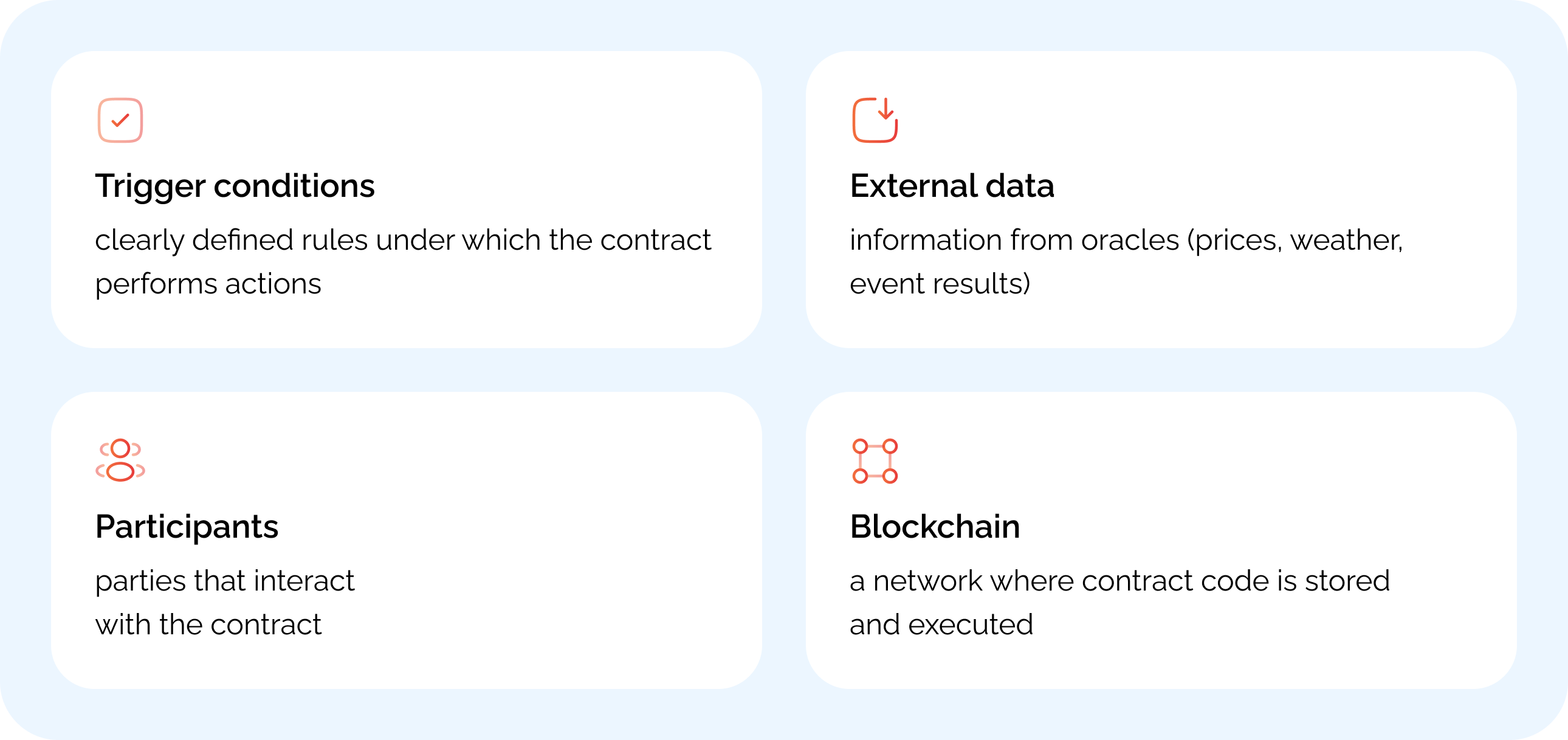
Elements involved in the execution of a smart contract
What are smart contracts?
- Simple (if-then) — work on the principle of “if this, then that.” Received the goods — pay the money. The plane was late — return the insurance. Suitable for typical operations.
- Complex (multi-level) — take into account several conditions and scenarios. For example, an oil supply contract that changes the price depending on the exchange rate, season, or political situation.
- Oracle — receive data from external sources: exchange rates from the stock exchange, temperature from a weather station, delivery confirmation from a GPS tracker. Without this data, the contract does not work.
- Multisig — require confirmation from several parties. Convenient for large transactions where security is important.
- Self-renewing — can change conditions without manual intervention, for example, automatically renewing a subscription or updating limits.
- Hybrid — combine several types (e.g., oracle + multisig) to take external data into account and simultaneously require the consent of several participants.
The simpler the task, the simpler the contract. But if necessary, smart contracts can even describe complex multilateral agreements.
Business areas where smart contracts are used
The areas of application for smart contracts are constantly expanding—from finance to intellectual property management.

The use of smart contracts in various industries
Finance and DeFi: $200 billion in trust
Over $200 billion is locked in decentralized finance — a telling sign of trust in the technology.
- Automatic lending — Compound and Aave issue loans secured by cryptocurrencies and instantly liquidate collateral when prices fall.
- Decentralized exchanges — Uniswap allows you to trade directly, without intermediaries.
- Asset management — Yearn Finance automatically searches for the most profitable strategies for your funds.
Logistics: from weeks to seconds
Walmart uses smart contracts to track products — the time it takes to identify problematic batches has been reduced from weeks to seconds.
Our team implemented a similar solution for a transport company: document processing time fell by 70%, and disputes over delivery times disappeared.
Real estate: goodbye, bureaucracy
Smart contracts automatically transfer ownership rights upon receipt of full payment, eliminating the need to visit notaries. When renting an apartment, payments are debited automatically, and smart locks block access in case of late payment.
Insurance: instant payouts
Parametric insurance works on the basis of measurable data: an earthquake is recorded by a seismograph, and payment is made automatically. A flight is delayed, and compensation is already in your account. No claims or evidence required.
Key advantages
Why are businesses actively implementing this technology? Let’s examine the facts.
Automation and cost reduction
Smart contracts eliminate the need for manual document processing and reduce administrative costs. Process automation allows companies to significantly reduce operating costs.
Increased security and transparency of transactions
The blockchain foundation ensures that no one can change the terms of the contract after it has been launched or manipulate its execution. Every action is recorded in a distributed ledger and is available for verification by all participants.
This means fewer disputes, lawsuits, and reputational risks for businesses.
Elimination of intermediaries and acceleration of transactions
Traditional processes involve many intermediaries: banks, notaries, brokers, lawyers. Each takes a commission and lengthens the execution chain.
Smart contracts reduce transaction processing time from days to minutes. Eliminating intermediaries saves significant amounts of money.
Real-life cases
Let’s take our project as an example. A couple of years ago, a large fuel company approached us. The problem was typical: refueling aircraft required a lot of paperwork and coordination between operators, airlines, and banks. Mutual settlements took 4–5 days.
We developed a smart contract for automatic refueling payments. Now all participants see the same data in real time. Once the aircraft is refueled, the volume is automatically recorded in the accounting system, the smart contract verifies the data, and the money is debited from the airline. No paperwork, phone calls, or approvals.
The result: settlement time was reduced from 4–5 days to 15 seconds. In six months, more than 100 flights were refueled without a single failure. Operators save hours on paperwork, and airlines have gained complete transparency of expenses.
“Previously, each refueling took half an hour of paperwork. Now, you press a button and the money is debited. Everyone is satisfied,” says the project manager.
Pitfalls
Facts you need to know:
Irreversibility of errors
An error in the code can cost millions. Once launched, it is almost impossible to correct the logic, so every line is checked multiple times.
Rigidity of conditions
In everyday life, parties can change an agreement. This does not work with a smart contract — the code is executed strictly as written, even if circumstances have changed.
Dependence on external data
The contract needs external data: the dollar exchange rate, temperature, delivery status. If the source transmits incorrect values, the contract will not work properly.
What in the end
Smart contracts are effective where there are clear rules and repetitive operations. If you have standard transactions, many intermediaries, or need instant transparency, this technology is the solution. Large companies are already automating payments, tracking deliveries, and paying insurance without human involvement.
But for complex contracts that require constant changes and human decisions, smart contracts are not yet suitable.
The main thing is that technology is a tool. Success depends on how it is used.
And in order to use smart contracts correctly, it is worth turning to professionals who will study the processes and select the optimal solution.
Rate this article!






Leave your comment