

Flutter: why it’s the best choice for mobile development
We often hear from clients: “Why does developing a mobile app cost as much as a new car?” The answer is simple: you are ordering two apps instead of one. Welcome to the world of native development.
Why companies are switching to Flutter
We regularly get approached by companies with a typical request: they need a mobile app to automate their business processes. Whether it’s an SFA system for sales reps, CRM for managers, or a platform for internal document management, the pattern is always the same.
The traditional approach means double the work: separate development teams, different technologies, and asynchronous releases. As a result, development and support costs are doubled.
Customers get a tool that works the same on any device. Businesses launch automation twice as fast and cheaper than originally planned.
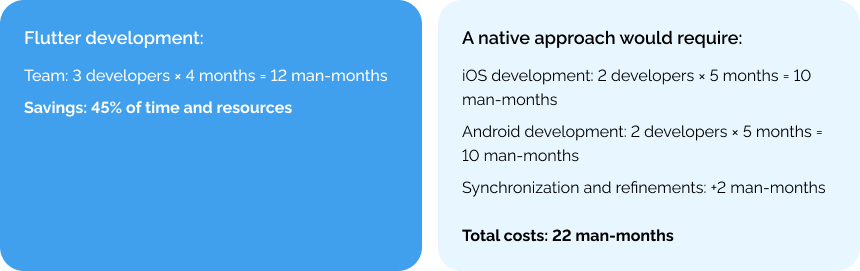
Practical calculation example for commercial application
But it’s not just about the numbers. With native development, every change has to be made twice — first on iOS, then adapted for Android.
Bugs also appear in two versions and have to be fixed separately.
Flutter solves this problem at its root: one code, one team, simultaneous releases on both platforms.
What has changed in Flutter over the past year
Impeller has become the primary engine on Android. In Flutter 3.27 (December 2024), Impeller finally replaced Skia on modern Android devices.
This eliminated issues with janky animations and made performance predictable across all platforms.
Web Hot Reload is no longer an experiment. In Flutter 3.35 (August 2025), hot reload on the web platform became a stable feature.
Developers got the same convenient workflow as on mobile platforms.
Material Design received fresh updates. Many widgets received the year2023: false flag to switch to the current design:
updated Slider, ProgressIndicator, RangeSlider with improved shapes and animations.
Cupertino widgets have become more accurate. CupertinoCheckbox, CupertinoRadio, and other elements now strictly follow Apple Human Interface Guidelines
with the correct sizes, colors, and behavior.
When to choose Flutter: practical criteria
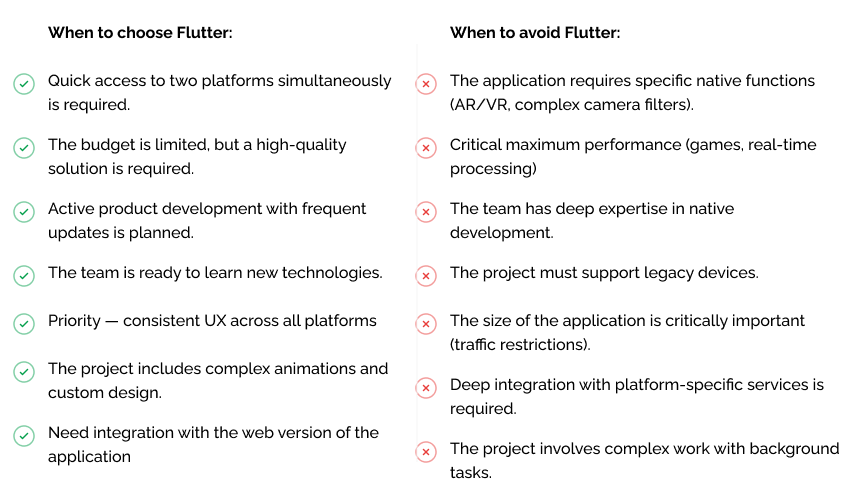
Illustration: Key considerations for choosing Flutter
Practical selection criteria:
- The app needs to be launched simultaneously on iOS and Android.
- The speed of bringing the MVP to market is important.
- The development and support budget is limited.
- The unified UI/UX must look the same on all devices.
- The app requires rich animation and custom design.
But honestly? Most projects work perfectly on Flutter, saving time and money.
How to make a decision: 5 simple steps
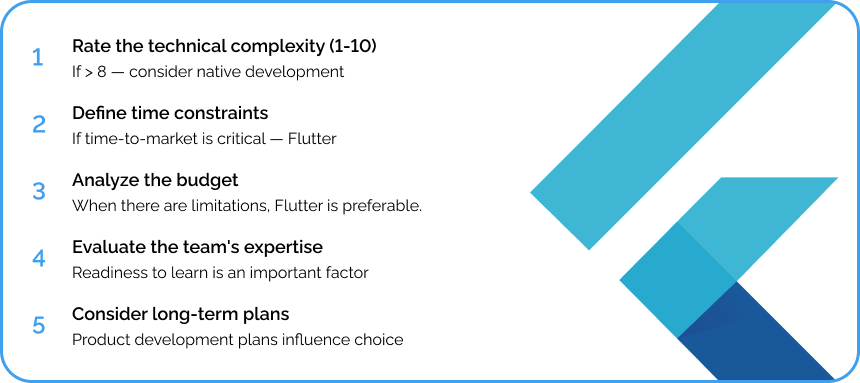
Decision-making process
Flutter vs React Native: a comparison in 2025
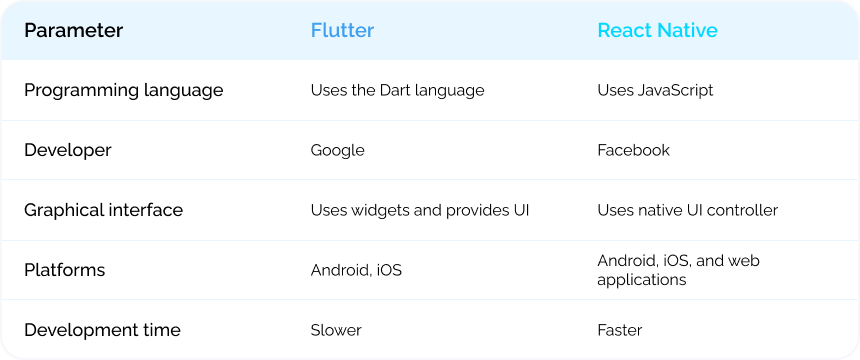
Flutter vs React Native
React Native has long been Flutter’s main competitor. If you are interested in Flutter development, let’s compare them fairly based on the main criteria:
- Programming language: Flutter uses Dart (simple and logical), React Native uses JavaScript (familiar to web developers).
- Developer: Flutter is developed by Google (more resources), React Native is developed by Facebook (unstable support).
- Graphical interface: Flutter uses widgets and provides a ready-to-use UI, while React Native uses a native UI controller.
- Platforms: Flutter supports Android, iOS, Web, and Desktop; React Native supports Android, iOS, and web applications.
- Development time: Flutter is slower at the start but faster in the long run.
Our verdict: If you are starting a new project in 2025, choose Flutter. If you already have a React Native team, you can continue, but keep Flutter on your radar.
Case study: SFA system for a trading company
A large trading company approached us with the task of automating the work of its sales representatives. We needed to create an application for planning visits, checking the availability of goods at points of sale, and placing orders on site.

Application for SFA
The functionality we implemented:
- Map with customer locations and routes
- Visit planning and tracking system
- Module for checking stock levels at retail outlets
- Mobile POS for placing orders
- Offline data synchronization
- Integration with corporate CRM
Project outcome:
- Development time: 4 months (instead of 8 on two native platforms)
- Consistent UX across all sales rep devices
- Full automation of field sales
- +40% increase in manager efficiency
The application is successfully used by a team of 150+ sales representatives throughout Russia and is integrated with the company’s core business processes.
Myth: “Flutter is Google’s experiment.”
Skeptics are convinced that Google is closing projects one after another, which means that Flutter is a risky bet.
The reality in 2025: Flutter has become the foundation of Google’s mobile strategy.
Google Ads, with revenues in the trillions of rubles, Google Pay, Google Earth — all these products run on Flutter.
In addition, Flutter is the basis for Fuchsia OS, Google’s new operating system.
Too much investment and reputational risk has been put into this project for it to simply be shut down.
Flutter app development timeline
In our experience, an MVP can be assembled in 2–3 months. A fully functional application takes 4–6 months, and a complex system with integrations can take up to 9 months.
With native development, these timescales increase by 40–60%. And while your competitors are wasting extra months, you can enter the market earlier.
Conclusion
Flutter in 2025 is like smartphones in 2010. You can continue to cling to push-button phones, but is it worth it? If you have an idea for a mobile app, let’s discuss whether Flutter is right for the job.
👉 Contact us for a preliminary assessment within 48 hours.
It’s time to stop paying for two developments. It’s time to choose the future.
Rate this article!




Leave your comment